
👀 Maybe as close as you can get to Sancerre for less than $20
03.12.2026
2024 Antoine Lafarge Pouilly Fumé
Shop this deal
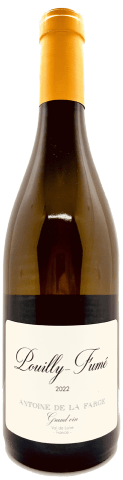
Antoine de la Farge Pouilly Fume
Like all of Antoine’s wines, this is farmed organically and skillfully crafted, from a region that has become harder and harder to find and, if you find it, it's harder to afford. The region now offers powerful and fruity Sauvignon Blanc, not at all like those of New Zealand. People lament that climate change has altered wines, but Sancerre and Pouilly-Fumé are often fruitier and more fun to drink as the weather heats up. Hooray, climate change?

Release Price: $32.50 USD (HERE)
SALE Price: $19.99 (net)
SAVE 38%
SALE runs Thursday March 12th - Sunday March 15th, 2026
Lowest Online Price in the USA!
Reminder we open at 9am today!
SALE ITEMS THIS WEEK:
$40 to $14.99 on iconic Napa Chardonnay
$12.99 for a perennial winestore favorite
There's a 100-million-year-old rock formation running through the Loire Valley that produces some of the most distinctive white wine on earth. The rock is called silex - ancient flint, left behind when prehistoric seas receded and the Cretaceous limestone eroded away. When you strike two pieces of silex together, you get a sharp, metallic smell. That smell is called pierre à fusil in French. Gunflint. It's also the smell you get in the glass when you pour a great Pouilly-Fumé.
That's where the name comes from. Fumé means smoky. The old-timers called Sauvignon Blanc grown here "Blanc Fumé" - smoky white - because of that haunting mineral note that great silex soils give to the wine. The best bottles smell like you just fired a flintlock pistol, then handed someone a glass of cold citrus and white flowers. It's one of the most singular aromatics in wine.
The problem? Pouilly-Fumé and its neighbor Sancerre have become increasingly difficult to find - and when you do find them, the prices have become increasingly difficult to justify.
Enter Antoine de la Farge.
His family has been making wine in this part of France since 1560. That's not a typo. Four and a half centuries. Sixteen generations. His grandfather, Gérard Clément, was one of the founders of the Menetou-Salon appellation back in 1959 and remains one of the most respected figures in the region. After spending eight years working in the wine trade - including a stint as a buyer for one of the largest wine merchants in France - Antoine came home in 2012 to take over the family vineyards and do things his own way.
His philosophy is simple: the winemaker is the "cement between the grape variety and the final wine." He's not trying to manipulate anything. No commercial yeasts. No pumping - everything moves by gravity. Hand-harvested. Organically farmed. He describes his job as a conductor transforming soil into music.
And the soil here is spectacular. Antoine's Pouilly-Fumé comes from vineyards that are 65% silex with the rest being caillottes - white chalk. This is the exact combination that produces the most electric, mineral-driven Sauvignon Blanc in the world.
Here's the part where you need to pay attention:
- Same grape as Sancerre? Correct.
- Same terroir as Sancerre? Indeed - both appellations sit on opposite banks of the Loire, sharing the same mix of Kimmeridgian limestone and silex soils.
- Same taste profile? Without a doubt
- Same price as Sancerre? Absolutely not. 😉
The most famous producer in Pouilly-Fumé history was a wild man named Didier Dagueneau - former professional motorcycle sidecar racer, long hair, dramatic beard, zero patience for mediocrity. In the 1980s, when the region was associated with overcropping and thin, weedy wines, he arrived and started publicly criticizing his neighbors. He tilled with horses. He dropped yields to 75% of what everyone else was harvesting. He made single-parcel wines when nobody else was doing that. His "Silex" bottling - named for the soil - became one of the most sought-after white wines in France, routinely selling for $150-$200+ per bottle. He died tragically in an ultralight plane crash in 2008, but his legend transformed how the world views Pouilly-Fumé.
Antoine de la Farge is cut from the same cloth - meticulous, uncompromising, obsessed with terroir - but without the Dagueneau price tag.
Same flinty silex soils. Same ancient winemaking lineage. Same electric, mineral-driven Sauvignon Blanc that Dagueneau made famous. A family that has been doing this since the year Shakespeare was born.
Quantities are scarce. They always are with producers this good at prices this low. If Sancerre is your thing, or Sauvignon Blanc is your thing, or you just want to understand what all the fuss is about with these ancient French soils that somehow translate into something you can smell in a glass - this is the one.
I know what I'm drinking tonight!